Environmental Issues
In the context of efforts to address climate change, the EAC has completed and continues to implement a series of strategic actions, which include:
- Conversion of all units at the Vasilikos Power Station to operate immediately upon the introduction of natural gas.
- Installation of a new unit (No. 6) at Vasilikos Power Station using natural gas as fuel.
- Installation of new, more efficient electricity generation units at Dhekelia Power Station and the simultaneous retirement of the existing energy-intensive units.
- Where operationally feasible, the company vehicle fleet is being upgraded from conventional to electric vehicles.
- Carbon dioxide emissions from the power stations and the EAC vehicle fleet are calculated, monitored and targeted.
- Monitoring of ground-level air quality using mobile units around the power stations.
- In 2023, a tender was announced for the upgrade of the outdated building management system (BMS) to a building energy management system (BEMS) at the EAC Headquarters.
Pollutants and greenhouse gas emissions
According to industrial emissions licenses, which also include waste disposal permits, the EAC submits an annual detailed assessment report to the Ministry of Labour regarding the results of pollutant measurements in gaseous emissions, as well as the disposal of liquid and solid waste from the boilers and gas turbines of the power stations.
Measurements of pollutant emissions from gaseous waste are conducted using specialised instruments at the power stations, which determine the concentration of exhaust gases in sulfur dioxide, nitrogen oxides, carbon monoxide, dust and other substances.
Minimizing carbon dioxide emissions is a primary goal for the generation core regulated activity (CRA), with daily generation planning favoring more efficient units to reduce fuel consumption and thus greenhouse gas emissions.
The operation of the new combined cycle unit No. 6 at Vasilikos Power Station is also expected to contribute to reducing greenhouse gas emissions by lessening the reliance on more energy-intensive units such as the steam units at Dhekelia Power Station and the open cycle turbines at Moni Power Station.
It is estimated that the introduction of natural gas will significantly reduce greenhouse gas emissions, as its carbon content per thermal kilowatt-hour is about 30% less than that of heavy fuel oil. EAC has nearly completed all the necessary modifications to allow steam and combined cycle units at Vasilikos Power Station to operate on natural gas.
Although greenhouse gas emissions can be reduced through optimal scheduling by the generation CRA, the emissions-per-megawatt-hour indicator has a fixed target. This is because, without the arrival of natural gas, significant reduction in emissions per megawatt-hour cannot be achieved due to the characteristics of liquid fuels and the efficiency of the existing units.
Even though the increased penetration of renewable energy sources (RES) in the production mix will lead to a reduction in total greenhouse gas emissions, it is not expected to change the combustion characteristics of the reduced conventional production per megawatt-hour, as the fuel and efficiency of the conventional units remain unchanged.
Therefore, greenhouse gas emissions per generated megawatt-hour can only be reduced by approximately 25-30% by switching from heavy fuel oil to natural gas.
Environmental responsibility and management
EAC acknowledges the environmental impacts resulting from its operations and aligns its business objectives with national environmental priorities, fully complying with legislation and its own self-imposed environmental commitments.
EAC applies an environmental management system based on the ISO 14001:2015 standard, certified by an independent body. This enables comprehensive evaluation of the environmental impact of its activities, recognition of environmental risks and opportunities, and monitoring and recording of gaseous emissions. As a result, it minimises the consumption of natural resources, mitigates the impact of emergency incidents and achieves comprehensive waste management.
Environmental impact from EAC operations
To assess environmental impact and define related management programmes, EAC has an established documented procedure.
The purpose of this procedure is to identify all elements and impact of the processes, materials and services of every EAC activity related to the environment, and to assess the significance of this impact based on its severity and likelihood. For significant impact, specific environmental programmes are designed per geographic area with detailed environmental objectives that are evaluated and revised annually.
Indicative actions to minimise environmental impact:
- Adoption of a new policy regarding the use of biodegradable insulating oil where its use is appropriate.
- Study of alternative biodegradable wood preservatives for use in treated wooden poles.
- In cooperation with government agencies, installation of pilot insulating cover applications to protect birds and local wildlife.
- In cooperation with the Forestry Department, planning the installation of insulated conductors or other equipment in specific areas to protect local fauna and flora (in case of damage).
- Use of low-sulfur heavy fuel oil (0.5%) in internal combustion engines.
- Monitoring and recording of pollutants (air, water, soil), aiming to avoid marine, air, and soil pollution.
- Installation of fire detection and suppression systems at Power Stations for immediate response to potential fires.
- Recycling of oils and other liquid waste.
- Measurement of air quality around the power stations.
- Pruning activities by EAC crews in forested areas near overhead lines. Additionally, under overhead transformers, dry vegetation is cleared, and insulators on high-voltage towers are washed and cleaned.
What environmental measures does EAC take to protect areas and communities around its power stations?
As part of its environmental policy, EAC applies an environmental management system and invests significant resources and efforts to control pollution and improve air quality in areas and communities around its three power stations. These measures include:
(i) Installation of anti-pollution technologies
(ii) Air quality monitoring using two specially equipped mobile units in areas near Vasilikos and Dhekelia Stations
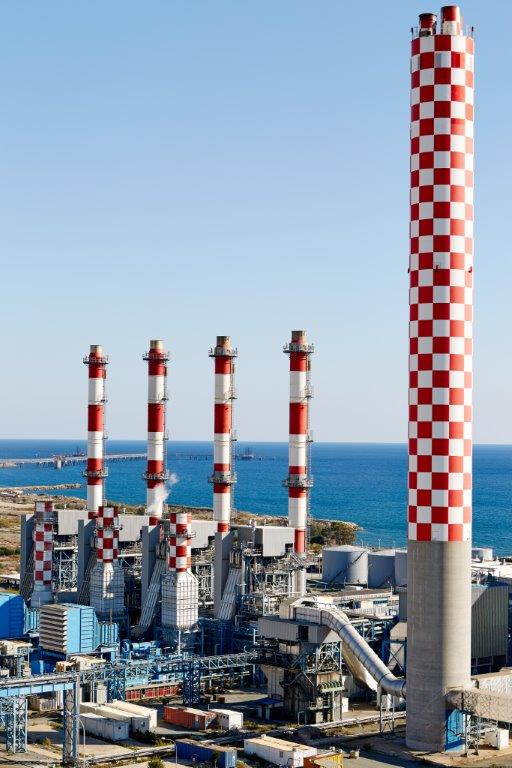
(iii) Better dispersion of emitted pollutants through tall exhaust chimneys
(iv) Use of high-quality heavy fuel oil with a maximum sulfur content of 1% in boilers and 0.5% in internal combustion engines
(v) Use of special low-NOx burners in boilers
Anti-pollution technologies at EAC power stations
EAC has installed various anti-pollution technologies to reduce pollutant emissions and comply with limits set by EU directives. The EAC has installed emission reduction systems for nitrogen oxides at the internal combustion engine (ICE1) units at Dhekelia Power Station, which became commercially operational in March 2017. It has also installed systems to reduce nitrogen oxides, sulfur dioxide, and dust at Units 1–3 of Vasilikos Power Station. Unfortunately, the installation of denitrification systems in Steam Units 1, 2 and 3 at Vasilikos Power Station has caused operational issues. As a result, these systems have been offline since June 2022.
EAC issued tenders addressed to the original boiler manufacturers aiming to repair these anti-pollution systems as soon as possible. Unfortunately, neither manufacturer has provided the necessary guarantees for the availability and efficient operation of the production units using liquid fuel (heavy fuel oil) with denitrification systems after the improvements. One manufacturer (for Boilers 1 & 2) does not even guarantee the availability and efficient operation of the units with natural gas. However, EAC has completed the installation of a denitrification system for Boiler No. 3, which will operate only when natural gas is used as fuel. Almost all necessary modifications have been made to these production units, along with the installation of additional required infrastructure, to allow the use of natural gas at Vasilikos Power Station. The final step is the functional tests, which will be conducted once natural gas arrives and is made available.